Middle East & North Africa (MENA)
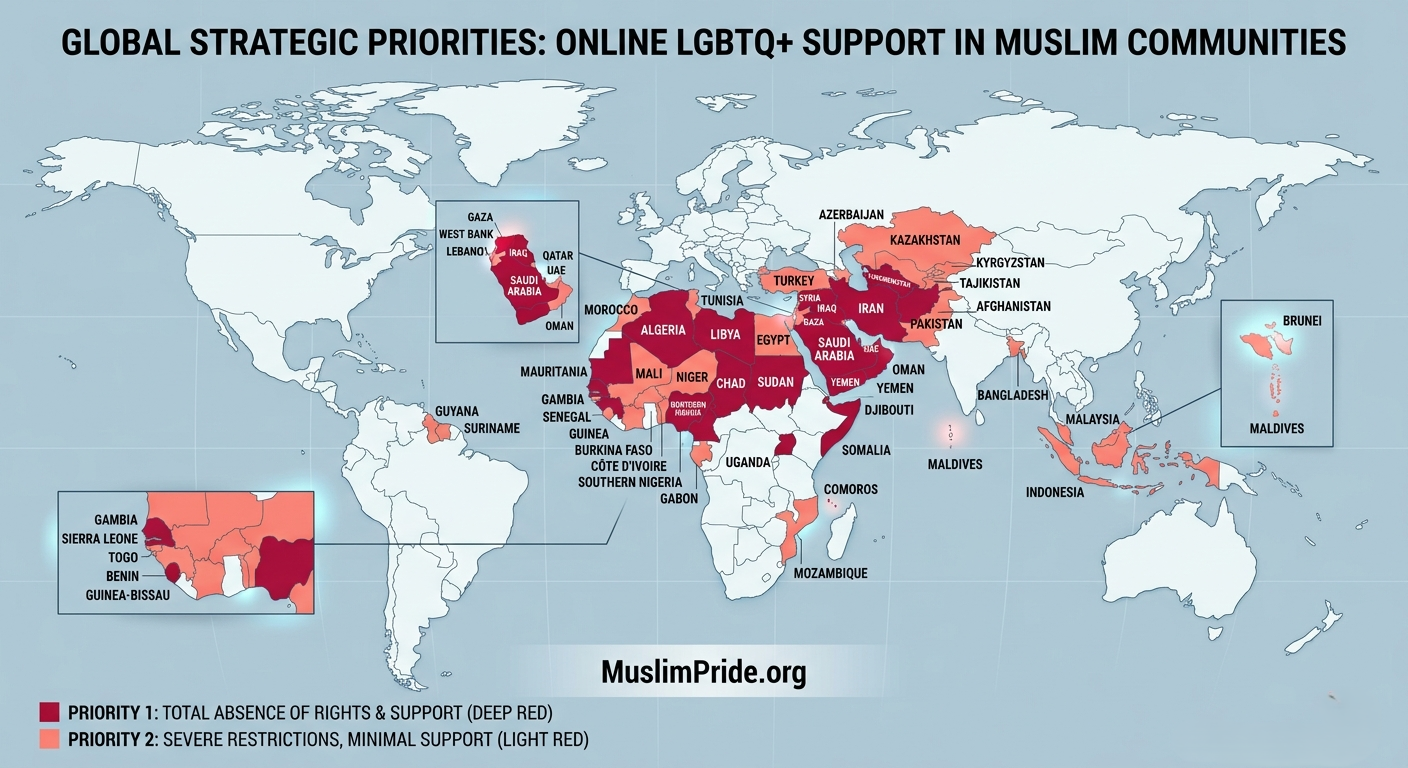
The MENA region presents the sharpest division between absolute exclusion and hidden resilience. In Red Zone countries like Saudi Arabia, Iran, and Qatar, the absolute synthesis of conservative religious governance and state surveillance apparatuses leaves no structural room for any physical LGBTQ+ infrastructure. The legal frameworks treat queer visibility as a national security threat or a capital offense, effectively wiping out any possibility of safe spaces. Conversely, in Light Red countries like Lebanon and Tunisia, historic civil society movements, relatively secular legal loopholes, and urban pluralism have allowed organizations like Helem and Mawjoudin to firmly establish roots. While social stigma remains severe, individuals in these countries can find physical venues or domestic websites to seek help, rendering them a lower priority for our basic digital intervention.
South & East Asia
In Asia, the availability of space is determined by the intersection of post-colonial penal codes and local community resilience. Afghanistan sits firmly in the Red Zone because the ruling regime enforces an absolute, violent eliminationist policy against LGBTQ+ individuals, making domestic digital or physical organization instantly fatal. In contrast, Pakistan and Bangladesh maintain colonial-era anti-sodomy laws, yet their societies possess deep-rooted historical spaces for third-gender communities (the Khawajasira), alongside resilient underground digital networks. Indonesia operates uniquely: while it does not federally criminalize homosexuality, regional autonomy laws (such as Sharia in Aceh) create localized zones of extreme danger, yet a sprawling network of established human rights NGOs exists across the archipelago to fight back.
Sub-Saharan Africa
The African OIC member states highlight a divide driven by modern political rhetoric and post-colonial law. In countries like Uganda, Somalia, and Mauritania, state regimes utilize aggressive anti-queer legislation and strict penal codes to consolidate political power, resulting in institutionalized violence, zero safe spaces, and the complete suppression of local data. Meanwhile, West African OIC members such as Benin, Côte d’Ivoire, and Mali present a completely different landscape: they do not explicitly criminalize same-sex acts in their penal codes. In major urban centers like Abidjan, queer spaces, commercial venues, and public health networks operate openly. While social conservative pressures are still widespread, the lack of state-level criminalization allows local activists to build basic support systems on the ground.
Europe & Central Asia
In this region, the post-Soviet landscape dictates safety. Turkmenistan and Uzbekistan remain strictly in the Red Zone as the last holdouts maintaining Soviet-era criminal laws against same-sex relations, enforced by high levels of police corruption and state isolation. The rest of Central Asia (Kazakhstan, Kyrgyzstan, Tajikistan) has decriminalized homosexuality on paper, but societal stigma keeps networks small and localized. Turkey is our prime example of a Light Red country: despite recent political crackdowns and bans on public marches, its long-standing legal status (decriminalized since the Ottoman era) has fostered a massive, visible ecosystem of queer culture, commercial safe spaces, and formal human rights networks in cities like Istanbul and Izmir. Albania, as an OIC member, is fully deprioritized (Green) because it enjoys comprehensive anti-discrimination laws and a highly visible domestic activist framework.
The Core Focus of MuslimPride.org
The analysis above proves why a targeted strategy is mandatory. In countries like India or Turkey, a queer Muslim looking for resources can tap into a pre-existing matrix of domestic activists, legal support, and local digital content.
However, for a young person sitting in Saudi Arabia, Iran, or Northern Nigeria, searching for local support yields nothing but dangerous state surveillance or absolute silence. They cannot walk into an underground café, they cannot contact a locally registered NGO, and they cannot find resources written for them.
This is exactly why MuslimPride.org exists. We concentrate our online infrastructure, translation assets, and security measures on the Red Zone countries. By stepping into the blank spaces where no domestic support is legally permitted to exist, we ensure that the most isolated members of our global Ummah are never truly alone.