The global landscape for LGBTQ+ individuals varies drastically. In some nations, vibrant local movements, legal organizations, or open community spaces exist, even amidst cultural challenges. In others, absolute state-enforced censorship or criminalization leaves queer individuals in total isolation.
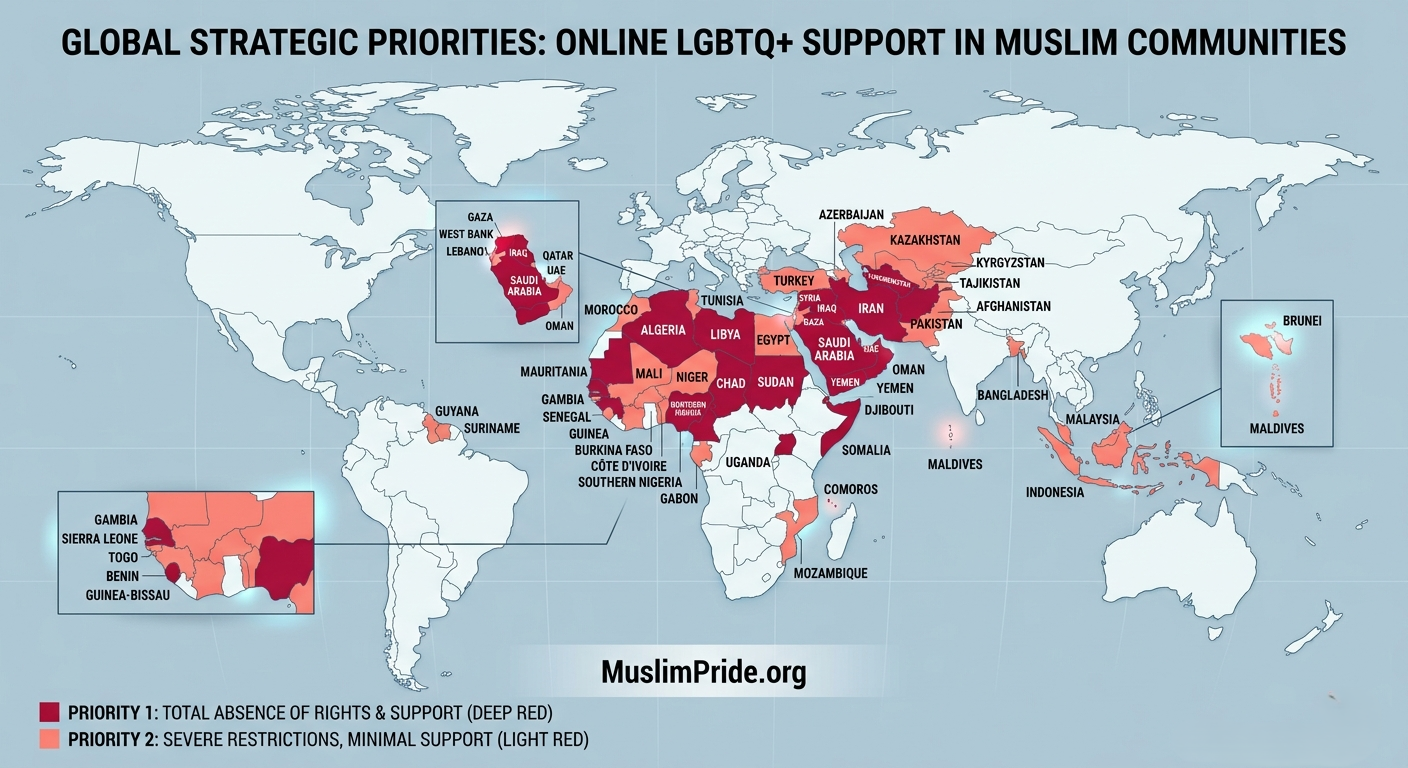
At MuslimPride.org, our mission is to act as a digital lifeline. To maximize our impact and use our resources effectively, we categorize countries based on the availability of local, accessible support systems. We consciously deprioritize regions where local infrastructure already exists—even if challenges remain—so we can focus intensely on the “Red Zone” countries: places where finding life-saving information locally is nearly impossible.
The Strategic Priority Matrix
This table categorizes all 57 OIC member states by continent and region, using your logic:
- Red (Priority 1): Total absence of legal rights, zero safe physical spaces, and extreme state or social danger. Total lack of local information.
- Light Red (Priority 2): Severe restrictions or criminalization, but small underground networks, specific activist groups, or limited open spaces exist.
- Green / Deprioritized (Priority 3): Countries with large Muslim populations or OIC status where a robust, visible network of LGBTQ+ organizations or legal frameworks already exists to provide guidance.
| Continent / Region | Country | Priority Tier & Color Code | Status Summary |
| Middle East & North Africa (MENA) | Saudi Arabia | Red (Priority 1) | Absolute criminalization; no public spaces. |
| Iran | Red (Priority 1) | Capital punishment; state-enforced isolation. | |
| Yemen | Red (Priority 1) | Death penalty risk; active conflict; no safety. | |
| Mauritania | Red (Priority 1) | Legal death penalty; total lack of infrastructure. | |
| Qatar | Red (Priority 1) | Strict criminalization; heavy digital monitoring. | |
| UAE | Red (Priority 1) | Strict anti-queer laws; total surveillance. | |
| Kuwait | Red (Priority 1) | Strict laws against gender non-conformity. | |
| Oman | Red (Priority 1) | Penal code criminalizes same-sex acts strictly. | |
| Gaza (Palestine) | Red (Priority 1) | Extreme social and legal danger locally. | |
| Syria | Red (Priority 1) | Conflict zone; strict criminalization. | |
| Iraq | Red (Priority 1) | Recent explicit anti-LGBTQ+ laws passed. | |
| Libya | Red (Priority 1) | Militia control; penal code criminalization. | |
| Algeria | Red (Priority 1) | Penal code explicitly criminalizes same-sex acts. | |
| Egypt | Light Red (Priority 2) | High danger, but digital networks and some local underground resources exist. | |
| Sudan | Light Red (Priority 2) | Recent legal updates removed death penalty, but high risk; small networks. | |
| Morocco | Light Red (Priority 2) | Criminalized, but has active underground digital magazines and hidden communities. | |
| Tunisia | Light Red (Priority 2) | Criminalized, but local registered NGOs (e.g., Mawjoudin) actively fight for rights. | |
| Lebanon | Light Red (Priority 2) | Active civil society, queer-friendly spaces in Beirut, and established NGOs (e.g., Helem). | |
| Jordan | Light Red (Priority 2) | Same-sex acts are legal on paper, but high social stigma; small community groups exist. | |
| West Bank (Palestine) | Light Red (Priority 2) | High stigma, but local organizations (e.g., alQaws) operate platforms. | |
| South & East Asia | Afghanistan | Red (Priority 1) | Extreme direct physical danger under current regime. |
| Brunei | Red (Priority 1) | Strict Syariah penal code implemented. | |
| Pakistan | Light Red (Priority 2) | Criminalized on paper, but vibrant trans (Khawajasira) community and underground digital spaces exist. | |
| Bangladesh | Light Red (Priority 2) | Criminalized, but home to historical activist groups (e.g., Boys of Bangladesh). | |
| Malaysia | Light Red (Priority 2) | High state persecution, but active underground defense groups (e.g., Jejaka) exist. | |
| Maldives | Light Red (Priority 2) | State religion enforces laws, but small hidden tourist/digital networks exist. | |
| Indonesia | Light Red (Priority 2) | Legally un-criminalized in most provinces, but rising regional crackdowns; active NGOs (e.g., Arus Pelangi) exist. | |
| Sub-Saharan Africa | Somalia | Red (Priority 1) | Extreme lawlessness and absolute penalty risks. |
| Nigeria (Northern) | Red (Priority 1) | Sharia states enforce death penalty; extreme danger. | |
| Uganda | Red (Priority 1) | Anti-Homosexuality Act passes extreme penalties. | |
| Gambia | Red (Priority 1) | Severe prison sentences; harsh political rhetoric. | |
| Senegal | Red (Priority 1) | High social violence and frequent prosecutions. | |
| Cameroon | Red (Priority 1) | High rate of arrests and physical violence. | |
| Comoros | Red (Priority 1) | Penal code criminalizes same-sex relations strictly. | |
| Djibouti | Red (Priority 1) | High social taboo; total lack of open resources. | |
| Chad | Red (Priority 1) | Recriminalized in recent years; high isolation. | |
| Sudan | Red (Priority 1) | High state surveillance; severe social restrictions. | |
| Nigeria (Southern) | Light Red (Priority 2) | Strict federal laws, but active underground activist networks and health NGOs exist. | |
| Sierra Leone | Light Red (Priority 2) | High stigma, but small grassroots community groups operate quietly. | |
| Togo | Light Red (Priority 2) | Criminalized, but small public health-focused support networks exist. | |
| Benin | Light Red (Priority 2) | Same-sex acts are legal, but social stigma is high; local advocacy is growing. | |
| Burkina Faso | Light Red (Priority 2) | Legally un-criminalized, but political instability limits advocacy. | |
| Côte d’Ivoire | Light Red (Priority 2) | Legal on paper; active commercial and safe spaces exist in main cities. | |
| Gabon | Light Red (Priority 2) | Briefly criminalized then repealed; small community networks exist. | |
| Guinea | Light Red (Priority 2) | Criminalized, but low enforcement; minor hidden networks. | |
| Guinea-Bissau | Light Red (Priority 2) | Legal since 1993; minimal infrastructure but lower state persecution. | |
| Mali | Light Red (Priority 2) | Socially difficult, but no explicit penal code ban. | |
| Niger | Light Red (Priority 2) | High religious opposition, but legally un-criminalized. | |
| Mozambique | Light Red (Priority 2) | Fully decriminalized; registered local LGBTQ+ organizations exist. | |
| Europe & Central Asia | Turkmenistan | Red (Priority 1) | One of the few post-Soviet states where homosexuality remains criminalized. |
| Uzbekistan | Red (Priority 1) | Homosexuality remains a criminal offense; high blackmail by police. | |
| Turkey | Light Red (Priority 2) | Legal since 1858; high current political opposition and bans on pride, but has massive public queer bars, visible activist networks, and legal associations. | |
| Azerbaijan | Light Red (Priority 2) | Legal on paper; high social stigma and police sweeps, but visible urban alternative spaces exist. | |
| Kazakhstan | Light Red (Priority 2) | Legal on paper; rising digital advocacy groups exist. | |
| Kyrgyzstan | Light Red (Priority 2) | Legal on paper, though facing conservative pushback; active local NGOs operate. | |
| Tajikistan | Light Red (Priority 2) | Legal on paper, but government keeps official “lists” of queer citizens; extreme stigma. | |
| Albania | Green (Deprioritized) | Full legal protection against discrimination; active open Pride events; no urgent need for basic info. | |
| Guyana (Suriname/Americas OIC) | Light Red (Priority 2) | Decriminalized recently; local support structures expanding. |